
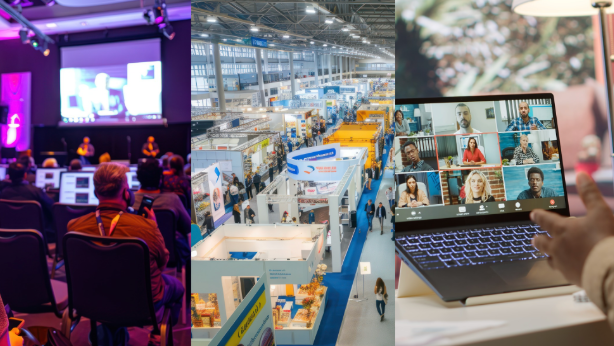
Key Differences : Hybrid Events vs Virtual vs In-Person
There was a time when events were simple. You showed up, or you didn’t.
Then came the screen. And with it, a quiet disruption. The room expanded. The audience multiplied. And suddenly, events were no longer bound by geography, capacity, or even time. Today, when we talk about events, we’re really talking about three distinct experiences like in-person, virtual events, and the increasingly dominant hybrid event. But reducing them to formats misses the point. They’re not just different ways to host events. They’re different ways to think about presence.
The In-Person Event: Where Energy Is Tangible
There’s something about being in the room that no technology has fully replicated. The handshake before a session begins. The spontaneous conversations between panels. The collective silence before an announcement.
In-person events thrive on unplanned moments, the kind that don’t translate easily into digital formats. They are immersive, yes! But also exclusive by design. Limited by venue capacity, travel budgets, and geography.
And yet, they remain irreplaceable. Because sometimes, proximity is the experience.
Virtual Events: Where Access Becomes the Experience
When events moved online, the first thing they lost was physicality. The first thing they gained was scale.
Virtual events dismantled the idea that attendance requires presence. With a strong virtual event platform, a keynote in Mumbai could be watched in New York, Nairobi, and Singapore simultaneously.
But access alone isn’t enough. The early days of virtual events were defined by replication. Stages became screens. Audiences became viewers. Engagement became a chat box. What followed was evolution.
Today, the best virtual event platform experiences are designed, not replicated. They integrate live streaming, interactive tools, breakout sessions, and analytics to create environments that are participatory, not passive. And behind these experiences is infrastructure. MultiTV, for instance, enables high-quality streaming and scalable delivery, ensuring that virtual audiences don’t just join, but stay. That buffering doesn’t break the moment. That distance doesn’t dilute the experience.
Because in a virtual world, technology is the venue.
Hybrid Events: Where Choice Becomes Power
If in-person is about presence, and virtual is about access, the hybrid event is about agency. It doesn’t force a decision between physical and digital. It offers both simultaneously. A hybrid event platform doesn’t just stream a physical event. It connects two audiences, those in the room and those beyond it, into a shared experience.
But here’s where it gets interesting. Hybrid events aren’t symmetrical. The in-person attendee experiences immersion. The virtual attendee experiences flexibility. The challenge, and the opportunity, is to design for both without compromising either. This is where most events falter. Streaming a stage isn’t enough. Mirroring a schedule isn’t enough.
A true hybrid experience requires intentional design, parallel engagement strategies, synchronized content delivery, and seamless integration between physical and digital touchpoints. This is where platforms and partners matter. With MultiTV’s expertise in live streaming and event technology, hybrid events can be executed with precision, ensuring real-time delivery, minimal latency, and consistent quality across audiences. The result isn’t two separate events running in parallel, but one cohesive experience unfolding across dimensions.
The Real Difference Isn’t Format. It’s Intent.
It’s tempting to compare these formats through a checklist.
Reach. Cost. Engagement. Scalability.
But the real difference lies deeper, in what each format prioritizes.
- In-person events prioritize connection through proximity
- Virtual events prioritize access through technology
- Hybrid events prioritize choice through integration
And that shift, from control to choice, is defining the future of events.
The New Event Landscape: Designed, Not Default
What we’re witnessing isn’t just a transition from one format to another. It’s a redefinition of what events are meant to do. Events are no longer just destinations. They are experiences designed across formats, devices, and expectations. A product launch might begin in a physical venue, extend into a global livestream, and continue as on-demand content. A conference might host workshops in person while enabling virtual networking rooms for remote attendees.
This fluidity requires more than creativity. It requires infrastructure that can support scale, flexibility, and reliability. MultiTV plays a foundational role in this ecosystem by powering everything from virtual events to complex hybrid event platform deployments with seamless streaming and delivery capabilities. As events become multi-dimensional, the backend becomes as important as the front row.
So, Which Format Wins?
The wrong question.
In-person events will never disappear. Virtual events will never stop evolving. Hybrid events will continue to grow.
The real question is: What does your audience need and how do you meet them there?
Sometimes, that means bringing people into a room.
Sometimes, it means reaching them where they are.
And sometimes, it means doing both.
Final Thought: The Future Is Not Either/Or
The future of events isn’t a replacement story. It’s a layered story.
Formats will coexist.
Experiences will overlap.
Audiences will expect options.
And the most successful events will not be defined by where they happen but by how well they adapt. Because in the end, the goal isn’t just attendance.
It is connection, on every level possible.
